
Racing Pigeon Performance DNA Test | Genetic Analysis for Racing Pigeon Potential
Advanced Genetic Performance Testing for Racing Pigeons
Racing pigeon performance DNA testing is a modern genetic analysis service designed to help pigeon breeders better understand the inherited biological characteristics of their pigeons.
Our laboratory analyzes selected genetic markers associated with important racing-related traits such as:
- Endurance
- Muscle performance
- Recovery ability
- Navigation-related biological functions
- Stress adaptation
- Metabolic efficiency
- Breeding potential
The purpose of this test is not to “predict race winners” with absolute certainty.
Instead, the goal is to provide scientific genetic reference information that helps breeders make more informed decisions in breeding, selection, and long-term racing management.
Genetics is only one part of racing pigeon performance. Training, nutrition, environment, health management, and breeding strategy also play critical roles.
However, genetic testing can help identify inherited biological advantages that may contribute to long-distance racing performance and breeding value.
Consultant: Martin.W
Email: [email protected]
Consultant: Aaron.W
Email: [email protected]
What Is a Racing Pigeon Performance DNA Test?
A racing pigeon performance DNA test is a molecular genetics analysis that evaluates specific genetic markers associated with physical and biological traits important in racing pigeons.
Every pigeon inherits genetic information from its parents.
Some genes influence:
- Muscle fiber characteristics
- Oxygen utilization
- Energy metabolism
- Recovery efficiency
- Cellular stress response
- Neurological signaling
- Endurance-related biological pathways
By analyzing these genetic variations, laboratories can build a genetic profile that provides additional insight into a pigeon’s inherited biological potential.
Why Genetic Analysis Matters in Racing Pigeons
Modern racing pigeon breeding has become increasingly scientific.
Traditional selection methods often rely on:
- Race results
- Appearance
- Bloodlines
- Breeder experience
- Training observation
These methods remain important.
However, genetics provides another layer of information that cannot be seen visually.
Two pigeons may look similar externally while carrying very different inherited biological traits.
DNA analysis helps breeders better understand:
- Which pigeons may carry stronger endurance-related genetics
- Which birds may have favorable recovery-associated markers
- Which breeding pairs may pass valuable traits to offspring
- Which bloodlines may contain stronger genetic consistency
Genetic testing does not replace breeder experience.
Instead, it supports breeder decision-making with molecular biological data.
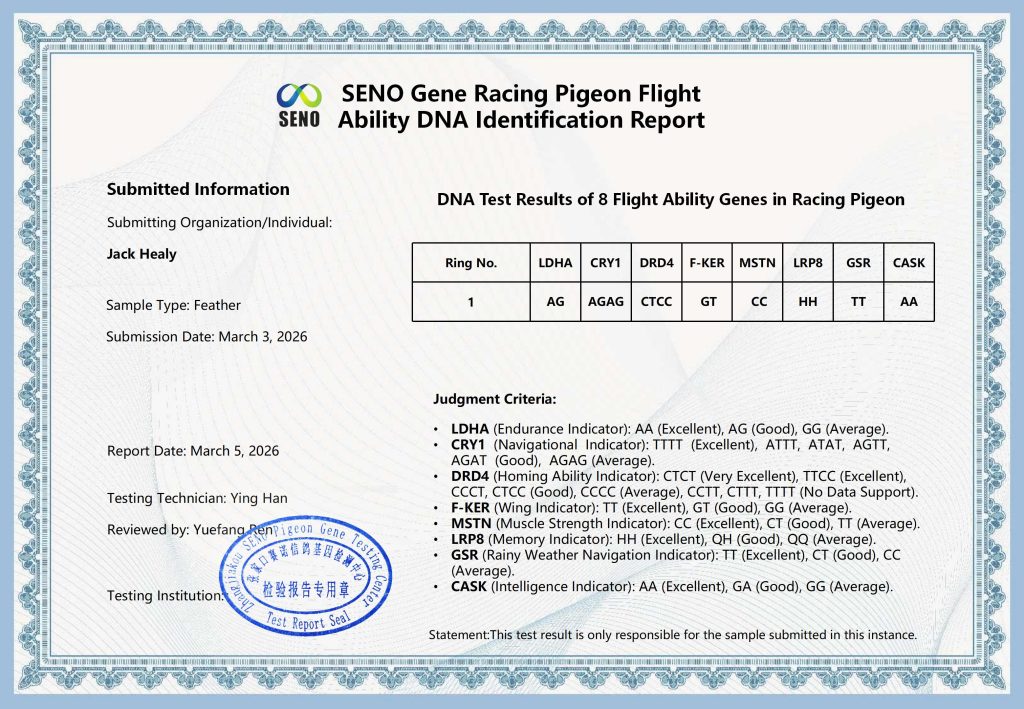
Understanding Your Genetic Report: Interpretation Criteria
Decoding the Genetic Blueprint: 8 Core Racing Pigeon Performance Markers
The detailed analysis below serves as your comprehensive guide to interpreting the genetic results. Based on the latest scientific literature and our Company’s proprietary laboratory data, these criteria link specific genotypes across 8 core loci to estimated flight performance and potential, providing you with the most up-to-date scientific insight and actionable breeding advice.
1. LDHA (Endurance / Speed Switch)
- 🟢Excellent Genotype (Top): AA
- 🔵Good Genotype: AG, GG
- Scientific Insight: Influences lactic acid metabolism efficiency and anaerobic threshold. The AA genotype is ideal for high-intensity, fast-paced races.
2. CRY1 (Navigational / Homing Perception)
- 🟢Excellent Genotype (Top): TT (or TTTT pure form)
- 🔵Good Genotype: CT, AT (or corresponding heterozygous profiles)
- Scientific Insight: This locus, a dinucleotide repeat sequence, is involved in regulating the circadian rhythm and the perception of the geomagnetic field essential for homing. TTTT is associated with optimal navigational ability.
3. DRD4 (Homing Ability / Motivation)
- 🟢Excellent Genotype (Top): CTCT (Very Exc.), TTCC (Exc.)
- 🔵Good Genotype: CCCT, CTCC
- Scientific Insight: Affects the dopamine receptor, strongly linked to homing instinct, memory, and motivation.
- ⚠️Caution: CCTT, CTTT, TTTT are categorized as No Data Support.
4. F-KER (Wing Quality / Aerodynamics)
- 🟢Excellent Genotype (Top): TT
- 🔵Good Genotype: GT, GG
- Scientific Insight: Affects feather keratin structure, determining the wing’s flexibility, recovery rate, and overall aerodynamic efficiency crucial for high-speed and long-distance flight.
5. MSTN (Muscle Strength / Explosive Power)
- 🟢Excellent Genotype (Top): CC
- 🔵Good Genotype: CT, TT
- Scientific Insight: The Myostatin gene regulates muscle growth. The CC genotype often results in superior explosive power and muscle volume.
6. LRP8 (Memory / Energy Efficiency)
- 🟢Excellent Genotype (Top): HH
- 🔵Good Genotype: QH, QQ
- Scientific Insight: Influences fatty acid utilization and storage efficiency, critical for sustained energy supply and memory consolidation during long flights.
7. GSR (Rainy Weather / Stress Response)
- 🟢Excellent Genotype (Top): TT
- 🔵Good Genotype: CT, CC
- Scientific Insight: Influences glutathione reductase activity, enhancing cellular antioxidant capacity and helping the pigeon maintain physiological stability under adverse weather or high stress.
8. CASK (Intelligence / Learning Capacity)
- 🟢Excellent Genotype (Top): AA
- 🔵Good Genotype: AG, GG
- Scientific Insight: Linked to neuronal synaptic stability and signal transduction. The AA genotype is potentially associated with stronger learning ability and greater racing stability.
How Racing Pigeon Performance DNA Testing Works
Step 1: DNA Sample Collection
The testing process begins with collection of biological samples.
Common sample types include:
- Feather follicles
- Blood samples
Fresh feather follicles are commonly used because they contain living cells with genomic DNA.
Proper sample quality is important for reliable genetic analysis.
Step 2: DNA Extraction
Laboratory technicians extract genomic DNA from the collected samples.
The extraction workflow isolates DNA suitable for molecular analysis and genetic marker detection.
DNA quality control procedures help ensure analytical reliability.
Step 3: Genetic Marker Analysis
The extracted DNA undergoes molecular analysis targeting selected performance-associated genetic markers.
These markers are analyzed using modern molecular biology technologies such as:
- PCR-based analysis
- SNP analysis
- Sequencing technologies
- Genotype detection systems
The laboratory evaluates genetic variations associated with biological performance pathways.
Step 4: Genetic Data Interpretation
After analysis is completed, the detected genetic information is reviewed and interpreted.
The laboratory organizes the results into a performance-related genetic profile.
The report may include information related to:
- Endurance-associated markers
- Recovery-related genetic traits
- Metabolic efficiency indicators
- Muscle-related biological pathways
- Breeding reference analysis
Step 5: Performance DNA Report Generation
Final laboratory reports are generated after internal verification and quality review.
The report provides breeders with a structured genetic reference profile for long-term breeding and racing management.
Secured Report Verification & Pedigree Integrity To protect the integrity of your bloodline investments and prevent certificate forgery, every SENO Performance DNA Report comes with a unique encrypted QR Code and verification ID. International buyers and auction platforms can instantly verify the authenticity of the genetic data directly via our secure official database.
Understanding Genetics in Racing Pigeons
One of the most common misunderstandings is believing that a single “champion gene” exists.
In reality, racing performance is highly complex.
Racing ability is influenced by:
- Multiple genes
- Training quality
- Loft environment
- Nutrition
- Disease management
- Race conditions
- Breeder experience
No single gene can guarantee race success.
Instead, performance results come from the interaction between genetics and management.
DNA testing helps identify inherited biological tendencies that may support better racing potential under proper conditions.
Genetic Traits Commonly Studied in Racing Pigeons
Endurance-Related Biological Functions
Long-distance racing pigeons require efficient energy utilization and sustained muscle activity.
Certain genetic markers may be associated with biological pathways involved in endurance adaptation.
Muscle Performance
Muscle-related genetic markers may influence:
- Muscle fiber characteristics
- Energy conversion efficiency
- Exercise adaptation
- Recovery speed
These biological functions may contribute to racing consistency.
Recovery and Stress Response
Recovery ability is extremely important in competitive racing.
Some pigeons recover faster after intensive flights, while others experience longer recovery periods.
Genetic variations associated with cellular stress response and recovery mechanisms may help explain part of this difference.
Metabolic Efficiency
Racing pigeons require efficient metabolic systems for long-distance energy management.
Certain genetic markers may influence:
- Energy utilization
- Oxygen transport pathways
- Fat metabolism
- Cellular energy balance
Breeding Potential
One major advantage of DNA testing is helping breeders evaluate breeding potential.
Even pigeons without major race records may carry valuable inherited genetic traits.
Genetic analysis can help breeders:
- Select breeding pairs more scientifically
- Improve bloodline consistency
- Reduce blind breeding decisions
- Better understand inherited characteristics
Why Racing Pigeon Genetics Is Becoming More Important
The global racing pigeon industry has become increasingly competitive.
High-value bloodlines and elite racing pigeons may represent significant investments.
As breeding programs become more advanced, many breeders are moving toward:
- Data-driven breeding
- Molecular genetics
- DNA verification
- Scientific selection systems
Genetic testing provides objective biological information that complements traditional breeding knowledge.
DNA Testing Does Not Replace Breeder Experience
Experienced breeders remain essential.
Genetics should not be viewed as a shortcut or replacement for:
- Loft management
- Training systems
- Feeding strategy
- Race observation
- Long-term breeding experience
Instead, molecular analysis provides additional information that may support better decision-making.
The best results often come from combining:
- Strong genetics
- Excellent management
- Proper training
- Healthy breeding systems
- Experienced breeder judgment
Laboratory Quality Standards
Our laboratory follows strict molecular testing SOP procedures throughout the genetic testing workflow.
Quality control procedures include:
- DNA quality assessment
- Internal control verification
- Repeat analysis when necessary
- Data consistency review
- Manual expert interpretation
- Multi-step laboratory verification
These procedures help maintain stable analytical reliability.
Laboratory Information
Testing Laboratory
Zhangjiakou SENO Testing Center Co., Ltd
Laboratory Director
Aaron Wong
Our Track Record (Full Year 2025 Statistics)
- Total Pigeon Performance Test samples processed: 3000+
- Laboratory analytical accuracy: 99.9%
- Main international submission regions: Middle East, North America, Oceania, and Europe
How to Understand the DNA Performance Test Results
One of the most important parts of racing pigeon DNA testing is helping breeders clearly understand what the results actually mean.
Our laboratory does not classify pigeons as simply “good” or “bad.”
Instead, the report evaluates genetic markers associated with biological performance pathways and organizes them into practical reference categories.
The purpose is to help breeders better understand inherited tendencies and breeding potential.
How the Results Are Evaluated
The laboratory analyzes selected genetic markers associated with:
- Endurance-related biological pathways
- Muscle performance
- Recovery ability
- Metabolic efficiency
- Stress adaptation
- Breeding consistency
The combined marker profile is then interpreted using internal comparative analysis standards.
Example Result Categories
Endurance Potential
High Endurance-Associated Profile
This result suggests the pigeon carries multiple genetic markers commonly associated with endurance-related biological functions.
Possible characteristics may include:
- Better long-distance adaptation
- More stable energy utilization
- Stronger sustained activity potential
- Improved long-flight biological efficiency
This does not guarantee race success, but it may indicate favorable inherited endurance-related traits.
Moderate Endurance-Associated Profile
This profile suggests the pigeon carries a balanced mixture of endurance-associated markers.
The pigeon may still perform very well depending on:
- Training quality
- Loft management
- Health condition
- Nutrition
- Environmental factors
Many successful racing pigeons fall within moderate genetic ranges.
Lower Endurance-Associated Profile
This result indicates fewer detected endurance-associated markers compared with internal reference standards.
However, this does not mean the pigeon cannot race successfully.
Actual performance is still strongly influenced by:
- Breeder management
- Conditioning
- Health
- Experience
- Racing environment
DNA analysis is only one part of the overall evaluation.
Frequently Asked Questions (FAQ)
Can this DNA test predict racing winners?
No. This genetic test does not predict racing winners or guarantee championship performance. It provides reference information about inherited endurance-associated biological tendencies that may influence long-distance adaptation, recovery efficiency, and energy metabolism. Actual racing performance still depends heavily on training quality, loft management, health condition, nutrition, weather, race distance, and breeder experience.
What does “High Endurance-Associated Profile” mean?
A High Endurance-Associated Profile means the pigeon carries a higher proportion of genetic markers statistically associated with endurance-related biological functions. These markers may be linked to aerobic metabolism, energy utilization efficiency, recovery capacity, neurological response, or long-distance adaptation. However, genetic association does not guarantee superior racing results.
Is a High Endurance result always better?
Not necessarily. A higher endurance-associated genetic profile may suggest stronger biological adaptation for longer races, but racing success depends on multiple interacting factors. Some pigeons with moderate or lower endurance-associated profiles may still achieve excellent results through superior conditioning, training systems, race strategy, health management, and environmental adaptation.
Can pigeons with a Lower Endurance profile still perform well?
Yes. Pigeons carrying fewer endurance-associated markers can still perform competitively, especially in sprint or middle-distance races. Genetics represents only one component of performance potential, while training intensity, muscle conditioning, respiratory efficiency, loft environment, and breeder management also play major roles.
What is the purpose of endurance genetic testing?
The purpose of endurance genetic testing is to provide breeders with scientific reference information about inherited biological tendencies. Genetic analysis may help support breeding selection, pairing strategy optimization, family line evaluation, and long-term breeding management decisions.
Does genetics completely determine racing performance?
No. Racing performance is considered a multifactorial trait influenced by both genetics and environmental conditions. Training programs, nutrition, disease prevention, stress management, weather conditions, transportation stress, and race experience all significantly affect racing outcomes.
Can two pigeons with similar genetics perform differently?
Yes. Even pigeons with highly similar genetic profiles may show very different racing performance due to differences in conditioning, loft environment, immune status, muscle recovery, training intensity, and breeder management systems.
What genes are commonly analyzed in racing pigeon endurance testing?
Racing pigeon endurance genetic analysis may include markers associated with muscle metabolism, neurological response, circadian rhythm regulation, recovery efficiency, and energy utilization pathways. Commonly studied genes include LDHA, DRD4, and CRY1, although endurance performance is influenced by multiple genes and complex biological interactions.
What is the LDHA gene?
The LDHA gene is associated with lactate metabolism and muscular energy conversion. In racing pigeons, LDHA-related markers are often studied for their potential relationship with endurance capacity and muscle energy efficiency during prolonged flight activity.
What is the DRD4 gene?
The DRD4 gene is associated with dopamine receptor signaling and neurological behavior traits. In pigeons and other animals, DRD4-related genetic variation has been studied for possible associations with behavior, response patterns, and environmental adaptability.
What is the CRY1 gene?
CRY1 is a circadian rhythm-related gene involved in biological clock regulation. Some studies suggest circadian rhythm mechanisms may influence orientation behavior, daily activity cycles, and long-distance navigation-related biological processes in birds.
Is racing pigeon genetic testing scientifically accepted?
PCR-based genetic analysis is widely used in molecular biology and animal breeding research. However, racing pigeon performance genetics should be interpreted as statistical biological association analysis rather than absolute prediction. Performance traits are complex and influenced by multiple genetic and environmental variables.
Are endurance-related genetics inherited?
Yes. Many biological traits associated with metabolism, recovery efficiency, muscle physiology, and neurological response have hereditary components. Genetic testing may help breeders evaluate inherited tendencies within breeding lines and family groups.
Can genetic testing replace race performance evaluation?
No. Genetic testing should be used as a supplementary breeding reference tool rather than a replacement for race records, pedigree analysis, physical observation, and breeder experience.
Why do some champion pigeons not show “High Endurance” profiles?
Racing success is influenced by many biological and environmental factors beyond the markers included in current genetic testing panels. A pigeon may achieve outstanding performance through exceptional conditioning, training systems, health management, orientation ability, environmental adaptation, or unmeasured genetic factors.
Is this test suitable for young pigeons?
Yes. Genetic testing is particularly useful for young pigeons because inherited biological tendencies can be evaluated before extensive race history becomes available.
What sample types are required?
Freshly plucked feather follicles are most commonly used for DNA extraction and analysis. Blood and tissue samples may also be accepted depending on laboratory protocols.
Why are feather follicles important?
The follicle contains living cells with genomic DNA required for molecular analysis. Feathers without intact follicles may not provide sufficient DNA quantity or quality for reliable testing.
Can contamination affect genetic testing?
Yes. Mixed feathers, external DNA contamination, or improper sample handling may interfere with PCR analysis. Proper collection and separate packaging are recommended to maintain analytical reliability.
How should breeders use the test results?
Results should be interpreted as scientific reference information and combined with race performance records, pedigree analysis, loft observation, physical conditioning evaluation, and long-term breeding experience when making breeding decisions.
Scientific Limitations & Important Interpretation Notes
Racing pigeon performance DNA testing is a probabilistic genetic analysis tool. It provides biological reference information based on genetic markers, not deterministic performance outcomes.
No Single Gene Controls Performance
There is currently no scientific evidence that a single gene can determine racing performance in pigeons.
Traits such as endurance, navigation ability, recovery speed, and racing consistency are influenced by multiple genes working together in complex biological pathways.
Therefore, performance-related traits should always be interpreted as multi-factor genetic influences rather than single-gene outcomes.
Polygenic Trait Structure
Racing performance is a polygenic trait, meaning it is controlled by many genes simultaneously.
Each gene may contribute a small biological effect, but no individual gene is solely responsible for overall racing ability.
The final phenotype (actual racing performance) results from the combined effect of multiple genetic interactions.
Environmental Dependency
Genetic potential is strongly influenced by environmental and management factors.
Key external factors include:
- Training system and intensity
- Nutrition and feeding strategy
- Health status and disease exposure
- Loft environment and stress level
- Weather and race conditions
Even pigeons with favorable genetic markers may underperform without proper training and environmental support.
Final Interpretation Principle
DNA test results should be interpreted as genetic tendency indicators, not absolute performance predictions.
The most accurate breeding decisions are achieved by combining:
- Genetic testing results
- Race performance history
- Physical observation
- Breeder experience
Scientific References & Genetic Evidence (DOI Sources)
The following peer-reviewed studies support the scientific basis of avian genetics, SNP variation, and performance-related gene associations in animals. These references are used to support general biological and molecular principles in performance DNA testing.
- Vignal, A., Milan, D., SanCristobal, M., & Eggen, A. (2002). SNP markers and their application in animal genetics. Genetics Selection Evolution. DOI: 10.1186/1297-9686-34-3-275
- Morin, P. A., Luikart, G., & Wayne, R. K. (2004). SNPs in ecology, evolution and conservation genetics. Trends in Ecology & Evolution. DOI: 10.1016/j.tree.2004.01.009
- Brumfield, R. T., Beerli, P., Nickerson, D. A., & Edwards, S. V. (2003). The utility of SNPs in population genetics inference. Trends in Ecology & Evolution. DOI: 10.1016/S0169-5347(03)00018-1
- Bustin, S. A., et al. (2009). MIQE guidelines for real-time PCR experiments. Clinical Chemistry. DOI: 10.1373/clinchem.2008.112797
- Heid, C. A., Stevens, J., Livak, K. J., & Williams, P. M. (1996). Real-time quantitative PCR. Genome Research. DOI: 10.1101/gr.6.10.986
- Ellegren, H. (2008). Comparative genomics and genetic markers in avian species. Nature Reviews Genetics. DOI: 10.1038/nrg2361