
Pigeon DNA Fingerprinting Test Services | 57 SNP Genetic Identity Verification for Racing Pigeons
Professional Pigeon DNA Fingerprinting Laboratory
Pigeon DNA fingerprinting is an advanced molecular genetic testing service used to establish a permanent genetic identity profile for racing pigeons through high-throughput SNP (Single Nucleotide Polymorphism) analysis.
Our laboratory uses DNA sequencing technology to analyze 57 genetic SNP loci from pigeon DNA samples and generate a unique genetic fingerprint profile for each bird.
This genetic identification system is widely used in the racing pigeon industry for:
- Pigeon identity verification
- Anti-fraud protection
- Pedigree verification
- Parentage testing
- Breeding management
- Racing pigeon authentication
- Ownership confirmation
- Genetic comparison between pigeons
- OLR winner identity verification
- DNA certified pigeon auctions
Each pigeon receives a unique DNA identity profile based on its SNP marker combination, similar to a biological genetic ID card.
Consultant: Martin.W
Email: [email protected]
Consultant: Aaron.W
Email: [email protected]
Pigeon DNA Fingerprinting Certificate (Sample)
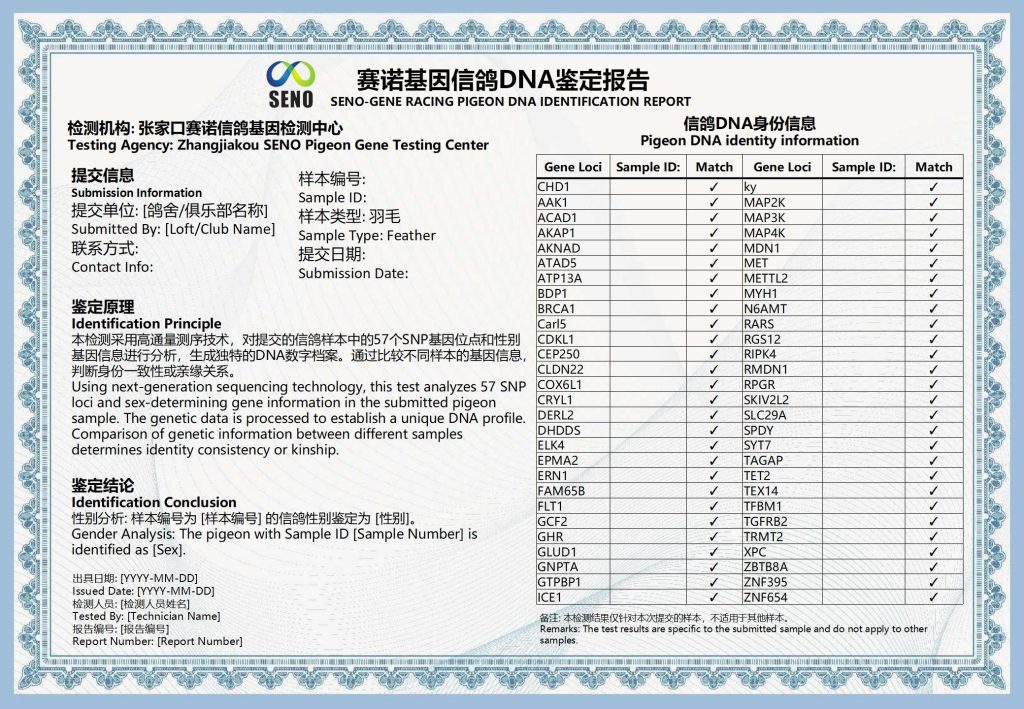
What Is Pigeon DNA Fingerprinting?
Pigeon DNA fingerprinting is a molecular genetics method used to uniquely identify individual pigeons through SNP marker analysis.
Unlike bird gender testing, which determines sex using CHD markers, DNA fingerprinting focuses on genetic individuality.
The laboratory analyzes multiple SNP loci distributed throughout the pigeon genome. The combination of SNP variations creates a highly specific genetic signature unique to each pigeon.
Because SNP combinations are inherited genetically:
- Each pigeon has a unique genetic profile
- Offspring inherit SNP patterns from both parents
- Related pigeons share predictable genetic similarities
- Unrelated pigeons show clear genetic differences
This allows laboratories to establish reliable identity and parentage relationships.
What Are SNPs in Pigeon DNA Testing?
SNP stands for:
Single Nucleotide Polymorphism
An SNP is a small genetic variation at a specific position in DNA.
For example:
At one genomic position:
- One pigeon may carry base A
- Another may carry base G
These tiny genetic differences are extremely useful for genetic identification.
By analyzing multiple SNP loci together, laboratories can create highly accurate pigeon genetic identity profiles.
Why 57 SNP Loci Are Used
Our laboratory analyzes 57 SNP loci for pigeon DNA fingerprinting.
Using multiple loci significantly increases identification reliability because:
- More loci provide stronger discrimination power
- The probability of unrelated pigeons sharing identical profiles becomes extremely low
- Parentage comparison becomes more accurate
- Fraud risk is reduced
- Genetic identity becomes more stable and reliable
The multi-locus SNP strategy is widely recognized in modern molecular identification systems.
💡 Laboratory Benchmarks: With 57 optimized SNP loci, our sequencing panel delivers a Cumulative Power of Exclusion (CPE) exceeding 99.999%, ensuring that the probability of two unrelated pigeons sharing the same genetic fingerprint is practically zero.
Scientific Principle of Pigeon DNA Fingerprinting
DNA fingerprinting is based on genetic inheritance patterns.
Each pigeon inherits DNA from:
- The father
- The mother
At every SNP locus:
- One allele originates from each parent
By comparing SNP combinations:
- Parent-offspring relationships can be verified
- Identity consistency can be confirmed
- Genetic mismatches can be detected
This forms the molecular foundation of pigeon genetic identity verification.
Our Pigeon DNA Fingerprinting Workflow
Step 1: DNA Sample Extraction
The testing process begins with genomic DNA extraction from pigeon biological samples.
Common sample types include:
- Feather follicles
- Blood samples
- Tissue samples
The laboratory uses optimized molecular extraction procedures to obtain DNA suitable for SNP sequencing analysis.
High-quality DNA extraction is important because sequencing accuracy depends on DNA integrity and concentration.
Step 2: SNP Sequencing Analysis
After DNA extraction, the samples undergo SNP sequencing analysis.
The sequencing workflow identifies genetic variations across 57 predefined pigeon SNP loci.
Modern sequencing systems allow laboratories to:
- Detect nucleotide variations
- Read SNP positions accurately
- Generate reproducible genetic data
- Compare genetic profiles computationally
Sequencing-based SNP analysis provides highly stable and precise genetic information.
Step 3: SNP Loci Data Collection
After sequencing is completed, the laboratory collects and organizes SNP locus information.
For each SNP locus:
- The detected genetic alleles are recorded
- Internal quality review is performed
- Sequencing consistency is evaluated
- Data integrity is verified
The combined SNP profile forms the pigeon’s genetic identity dataset.
Step 4: Generation of the Genetic Identity Profile
The final step is creation of the pigeon genetic fingerprint profile.
The report contains:
- Individual SNP locus results
- Genetic identity information
- Parentage comparison data (if applicable)
- Laboratory verification details
- Sample identification information
This genetic profile functions as a permanent molecular identity record for the pigeon.
Individual ID Profiling
Establish a permanent, life-long molecular ID for elite racers, premium stud birds, or high-value auction candidates.
Parentage Trios / Duos Test
Compare the offspring’s SNP profile against the alleged Sire (Father) and Dam (Mother) to confirm 100% biological lineage and verify pedigrees.
Why DNA Fingerprinting Is Important in Racing Pigeons
DNA fingerprinting has become increasingly important in the racing pigeon industry because of the growing value of elite pigeons and breeding lines.
Preventing Fraud in Pigeon Trading
One of the main applications of pigeon DNA fingerprinting is anti-fraud verification.
High-value racing pigeons may be:
- Sold internationally
- Used for breeding programs
- Entered into competitions
- Traded based on pedigree reputation
DNA fingerprinting helps verify:
- The true identity of the pigeon
- Consistency with claimed records
- Authenticity of breeding lineage
This reduces the risk of identity substitution and pedigree fraud.
Parentage Verification for Racing Pigeons
DNA fingerprinting is also widely used for pigeon parentage testing.
By comparing SNP profiles:
- Biological parents can be verified
- Breeding claims can be confirmed
- Lineage authenticity can be validated
Parentage testing is especially important in:
- Professional breeding programs
- High-value racing pigeon sales
- International breeding certification
- Competitive pigeon bloodline management
Why SNP Sequencing Is More Reliable Than Visual Identification
Visual identification methods rely on:
- Leg bands
- Appearance
- Records
- Ownership claims
However:
- Rings can be replaced
- Records may be falsified
- Appearance can be misleading
DNA fingerprinting analyzes inherited genetic information directly, making identity verification significantly more reliable.
Advantages of SNP-Based Pigeon DNA Fingerprinting
High Specificity
Multiple SNP loci create highly individualized genetic profiles.
Strong Reproducibility
Sequencing-based analysis provides stable and repeatable results.
Parentage Verification Capability
SNP inheritance patterns allow biological relationship analysis.
Permanent Genetic Identity
DNA profiles remain stable throughout the pigeon’s lifetime.
Reduced Fraud Risk
Genetic identity verification improves transparency in pigeon trading and breeding.
Quality Control and Laboratory Standards
Our laboratory follows strict molecular testing SOP procedures throughout the DNA fingerprinting workflow.
Quality control measures include:
- DNA quality assessment
- Sequencing consistency review
- Internal control analysis
- Data verification procedures
- Manual expert interpretation
- Repeat verification when necessary
These procedures help maintain analytical reliability and stable testing performance.
Laboratory Information
Testing Laboratory
Zhangjiakou SENO Testing Center Co., Ltd
Laboratory Director
Aaron Wong
2025 Pigeon Genetic Testing Statistics
- Total pigeon DNA fingerprinting samples processed: 200+
- Laboratory analytical accuracy: 99.9%
- Main international regions: Middle East, North America, Oceania, and Europe
Applications of Pigeon DNA Fingerprinting
Pigeon DNA fingerprinting is widely used for:
- Racing pigeon identity verification
- Parentage testing
- Pedigree authentication
- Breeding management
- Anti-fraud verification
- Genetic record systems
- International pigeon trade verification
- Bloodline protection
Why Molecular Genetic Verification Is Becoming Essential
As the global racing pigeon industry continues to grow, genetic verification is becoming increasingly important.
Molecular DNA fingerprinting provides:
- Scientific verification
- Objective identity confirmation
- Long-term traceability
- Breeding transparency
- Stronger pedigree reliability
This makes SNP-based pigeon genetic testing one of the most valuable molecular tools in modern racing pigeon management.
Frequently Asked Questions (FAQ)
What is pigeon DNA fingerprinting?
Pigeon DNA fingerprinting is a genetic identification method that uses SNP analysis to create a unique DNA identity profile for a pigeon.
What does SNP mean?
SNP stands for Single Nucleotide Polymorphism, which refers to small DNA sequence variations between individuals.
Why are 57 SNP loci used?
Using multiple SNP loci increases identification accuracy and improves parentage verification reliability.
Can DNA fingerprinting prove pigeon parentage?
Yes. Because SNPs follow strict Mendelian inheritance patterns (inheriting one copy from each parent), comparing the SNP profile of an offspring against its alleged sire and dam allows our laboratory to verify biological parentage with absolute scientific certainty.
Why is DNA fingerprinting important in racing pigeons?
DNA fingerprinting helps prevent fraud, verify pedigrees, confirm identity, and protect valuable breeding bloodlines.
What samples can be used?
Common sample types include feather follicles, blood samples, and tissue samples.
Is the DNA profile permanent?
Yes. A pigeon’s SNP profile remains stable throughout its lifetime.
Can two pigeons share the same SNP profile?
The mathematical probability is virtually impossible. Utilizing our advanced 57-loci SNP profiling panel, the discrimination power is high enough to ensure each individual pigeon possesses a truly unique genetic signature (except for rare identical twins).
Why is sequencing-based SNP testing reliable?
Sequencing directly analyzes genetic nucleotide variations, providing highly reproducible and precise molecular data.
Scientific References
- Vignal, A., Milan, D., SanCristobal, M., & Eggen, A. (2002). A review on SNP and other types of molecular markers and their use in animal genetics. Genetics Selection Evolution, 34(3), 275–305. DOI: https://doi.org/10.1186/1297-9686-34-3-275
- Morin, P. A., Luikart, G., & Wayne, R. K. (2004). SNPs in ecology, evolution and conservation. Trends in Ecology & Evolution, 19(4), 208–216. DOI: https://doi.org/10.1016/j.tree.2004.01.009
- Brumfield, R. T., Beerli, P., Nickerson, D. A., & Edwards, S. V. (2003). The utility of single nucleotide polymorphisms in inferences of population history. Trends in Ecology & Evolution, 18(5), 249–256. DOI: https://doi.org/10.1016/S0169-5347(03)00018-1
- Butler, J. M. (2015). The future of forensic DNA analysis. Philosophical Transactions of the Royal Society B, 370(1674). DOI: https://doi.org/10.1098/rstb.2014.0252