
Which System Is Better for Bird Gender Testing, Avian Virus Detection, and Racing Pigeon Genetics?
In modern avian laboratories, one of the biggest technical decisions is:
Should a bird DNA testing lab use traditional PCR or RT-PCR equipment?
At first glance, the answer may seem simple:
- Traditional PCR is cheaper
- RT-PCR is more advanced
But after years of operating a real commercial bird DNA laboratory at SENO Avian DNA Test Center, we discovered something important:
The true difference is not only the machine itself.
The real difference appears in workflow efficiency, labor cost, scalability, contamination control, and customer service speed.
This article explains the practical differences between RT-PCR and traditional PCR using real examples from:
- bird gender testing
- avian virus testing
- racing pigeon genetic analysis
We will also explain:
- why many laboratories eventually transition to RT-PCR
- why traditional PCR still remains valuable
- and how different technologies fit different business models.
Direct Answer: RT-PCR vs Traditional PCR
Both RT-PCR and traditional PCR are important technologies in bird DNA testing laboratories.
However, they are optimized for different situations.
In simple terms:
| Traditional PCR | RT-PCR |
|---|---|
| Lower startup cost | Higher startup cost |
| More manual operation | More automation |
| Requires gel electrophoresis | Fluorescence detection |
| Slower for large sample volume | Faster for high throughput |
| Good for small labs | Better for commercial scaling |
| Easier entry-level setup | Better long-term efficiency |
A useful analogy is this:
Traditional PCR is like printing photographs and developing them manually in a darkroom.
RT-PCR is like using a modern digital camera with automatic image processing.
Both can produce excellent results.
But once volume becomes large, automation changes everything.
What Is PCR in Bird DNA Testing?
PCR stands for:
PCR=Polymerase Chain Reaction
The goal of PCR is simple:
Take a tiny amount of DNA and make millions of copies so the laboratory can detect it.
Bird DNA samples usually contain very small amounts of genetic material.
For example:
- feather follicles
- blood spots
- oral swabs
- cloacal swabs
Without amplification, the DNA would be too little to analyze.
A simple visualization:
Tiny DNA Sample→PCR Amplification→Millions of DNA Copies
What Is the Real Difference Between RT-PCR and Traditional PCR?
Many articles oversimplify this question by saying:
“The difference is how results are detected.”
Technically this is true—but in real laboratories, the difference is much deeper.
The two systems behave almost like two different production philosophies.
Traditional PCR: Amplify First, Analyze Later
Traditional PCR works in two major stages:
Step 1 — DNA Amplification
The PCR machine repeatedly heats and cools samples to amplify DNA.
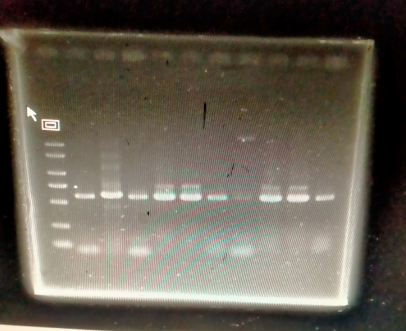
Step 2 — Gel Electrophoresis
After amplification, technicians must:
- prepare agarose gel
- add dye
- manually load samples
- run electrophoresis
- visualize DNA bands using UV light
This is where most of the hidden labor appears.
A useful analogy:
Traditional PCR is like baking bread and then manually inspecting every loaf afterward.
The PCR machine itself finishes quickly.
But the verification process requires:
- more time
- more equipment
- more technicians
- more handling steps
RT-PCR: Detection Happens During Amplification
RT-PCR (Real-Time PCR or qPCR) works differently.
Instead of waiting until the end to inspect DNA manually, the machine monitors amplification in real time using fluorescence signals.
A probe acts somewhat like:
a glowing tracking beacon attached to the DNA reaction.
As amplification occurs:
- fluorescence increases
- curves appear automatically
- software analyzes results instantly
This means:
- no gel electrophoresis
- no manual DNA band inspection
- less sample handling
- faster reporting
A simple analogy:
Traditional PCR is like checking student exam papers manually after class.
RT-PCR is like a computer grading every answer automatically while the test is still happening.
Why We Switched Most Bird Gender Testing to RT-PCR
At SENO laboratory, bird gender testing is our largest testing category.
We process:
- hundreds of samples daily
- often 30–60 samples per bird farm shipment
- sometimes much more during peak breeding seasons
Years ago, we initially believed traditional PCR was cheaper.
On paper:
- traditional PCR reagents were less expensive
- equipment investment was lower
But large-scale operation changed our understanding completely.
The Hidden Bottleneck: Gel Electrophoresis
The biggest problem was not PCR itself.
The problem was:
running gels.
A standard PCR machine can process:
96 Samples Per PCR Run
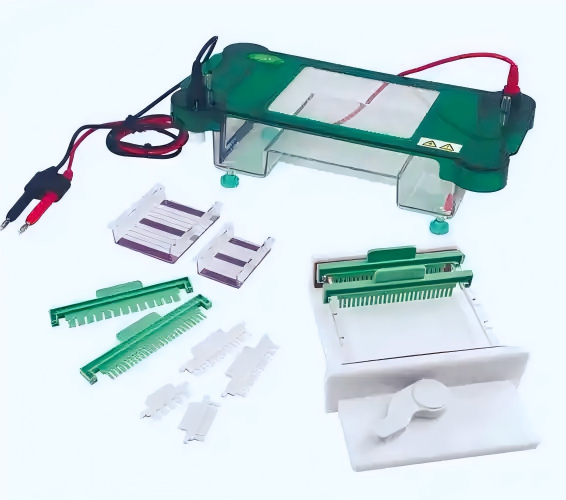
But a typical gel electrophoresis setup may only process:
12 Samples Per Gel Run
This creates a severe imbalance.
The PCR machine becomes fast.
The gel workflow becomes slow.
Real Example From Our Laboratory
Suppose we receive:
150 Bird Gender Samples
RT-PCR Workflow
Using:
- 2 RT-PCR machines
- 96-well systems
Typical timeline:
| Step | Time |
|---|---|
| Sample preparation | ~1 hour |
| RT-PCR run + automatic analysis | ~1 hour |
| Total | ~2 hours |
Traditional PCR Workflow
PCR amplification time may be similar.
But afterward:
- gels must be prepared
- samples loaded manually
- electrophoresis performed
- results interpreted visually
If one gel handles only 12 samples:
150 Samples÷12≈13 Gel Runs
Even with:
- 8–10 gel boxes
- multiple technicians
the laboratory may still require:
- several additional hours
- much more labor
- much higher contamination risk
This is where RT-PCR becomes economically superior.
The Surprising Reality: Labor Costs Become Bigger Than Reagent Costs
This was one of the biggest lessons from our laboratory experience.
Initially we focused on:
- reagent price
- equipment price
But once sample volume increased, we discovered:
Labor became more expensive than reagents.
Traditional PCR requires:
- more technician time
- more repetitive handling
- more manual interpretation
- more workflow management
Meanwhile, RT-PCR automates much of the process.
Why RT-PCR Reagent Costs Become Less Important at Scale
Another misconception is:
“RT-PCR reagents are always much more expensive.”
Partly true—but incomplete.
The most expensive part of RT-PCR is often:
- fluorescent probes
However, in large-scale laboratories:
- bulk purchasing lowers cost
- large reagent consumption improves efficiency
- automation reduces labor dependence
Eventually:
- labor savings outweigh probe cost differences
This is why many high-throughput laboratories eventually move toward RT-PCR systems.
Why Faster Results Matter in Bird DNA Testing
Customers rarely think about laboratory workflow.
What they really care about is:
- fast results
- reliable reports
- minimal delays
For bird breeders:
- delayed sexing means delayed sales
- delayed pairing decisions
- delayed breeding schedules
Fast turnaround directly improves customer experience.
RT-PCR greatly improves:
- reporting speed
- operational flow
- scalability
This is one reason why many modern bird DNA laboratories prioritize RT-PCR systems.
RT-PCR vs Traditional PCR in Avian Virus Testing
Virus testing creates a different situation.
Interestingly:
The difference between traditional PCR and RT-PCR is smaller in some virus research workflows.
At SENO laboratory:
- RT-PCR is usually the primary method
- traditional PCR is sometimes used as secondary verification
Why RT-PCR Dominates Virus Testing Research
RT-PCR offers several important advantages:
1. Higher Sensitivity
Low viral load detection is easier.
2. Quantitative Analysis
CT values provide additional information.
3. Faster Response
Critical for outbreak control.
4. Multiplex Detection
Multiple pathogens can be tested simultaneously.
The “Weak Positive” Problem
Real laboratory work is rarely black and white.
Sometimes:
- fluorescence curves appear clearly
- but CT values fall outside confirmed positive thresholds
These cases may be classified as:
weak positives
In such situations:
- traditional PCR may still help
- gel verification provides secondary evidence
This is why traditional PCR still remains useful in research laboratories.
RT-PCR vs Traditional PCR in Racing Pigeon Genetics
This is where RT-PCR becomes overwhelmingly more practical.
Modern racing pigeon performance genetic testing often involves:
- multiple genetic loci
- fluorescence comparison
- genotype interpretation
Traditional gel PCR becomes extremely difficult here.
Example: CRY1 Testing
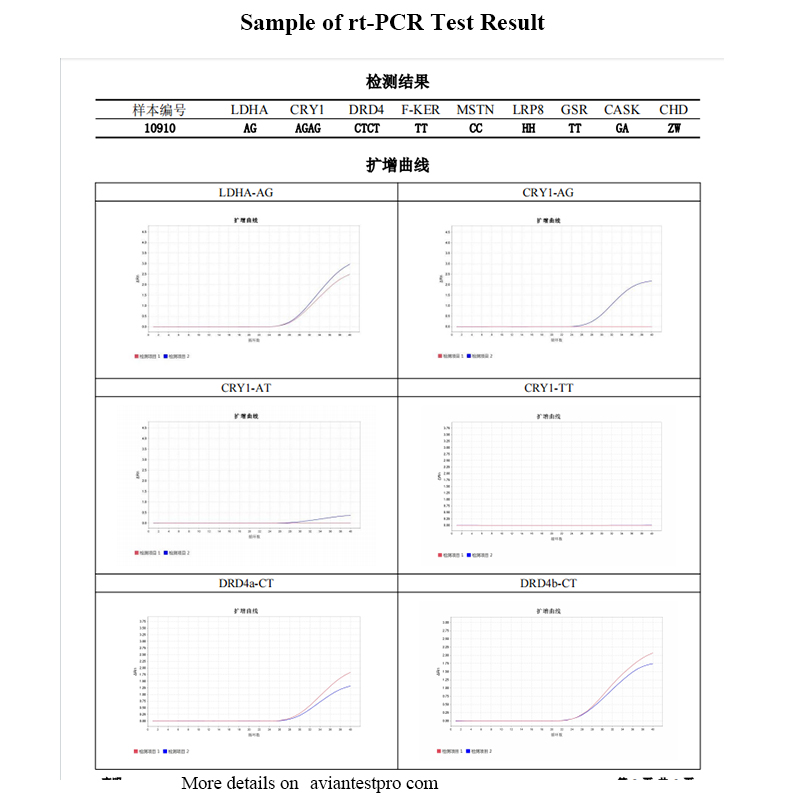
CRY1 analysis may involve:
3 Genetic Loci Comparison
The genotype is determined by:
- overlapping fluorescence curves
- CT value relationships
- signal interpretation
This is very difficult using gel electrophoresis alone.
Example: DRD4 Testing
DRD4 testing may involve:
2 Fluorescence Marker Curves
Again:
- RT-PCR is far more practical
- multiplex analysis is easier
- automation improves consistency
Why Modern Racing Pigeon Genetics Uses RT-PCR or Sequencing
Modern performance-related pigeon genetics increasingly depends on:
- multi-locus analysis
- fluorescence detection
- scalable workflows
- high-throughput automation
This is why:
- RT-PCR
and - sequencing technologies
have become dominant in advanced racing pigeon genetic laboratories.
Is Traditional PCR Still Valuable?
Absolutely.
Traditional PCR still has major value in:
- small startup laboratories
- educational environments
- low-volume testing
- secondary verification
- budget-sensitive operations
The technology is still scientifically valid.
The main issue is scalability.
Which System Should a New Bird DNA Lab Choose?
The answer depends on:
- sample volume
- budget
- business model
- long-term goals
Traditional PCR Is Better For:
- low startup budget
- educational use
- low daily sample volume
- learning molecular biology workflows
RT-PCR Is Better For:
- commercial scaling
- high-throughput bird sexing
- avian virus testing
- racing pigeon genetics
- fast turnaround services
- reduced labor dependency
Summary
The difference between RT-PCR and traditional PCR is not simply:
“old technology vs new technology.”
The real difference is:
- workflow architecture
- scalability
- labor efficiency
- contamination control
- reporting speed
- operational economics
At SENO Avian DNA Test Center, our experience processing large-scale bird DNA testing has shown that:
As sample volume grows, efficiency becomes more important than theoretical reagent savings.
Traditional PCR remains valuable.
But for modern commercial bird DNA laboratories handling:
- bird gender testing
- avian virus analysis
- racing pigeon genetic research
RT-PCR has become the more scalable and practical solution.
Frequently Asked Questions
Is RT-PCR more accurate than traditional PCR?
Both can be highly accurate when optimized correctly. RT-PCR offers better automation and easier contamination monitoring.
Why do large bird DNA labs prefer RT-PCR?
Because high sample volume makes manual gel electrophoresis inefficient and labor-intensive.
Is traditional PCR outdated?
No. It still has value for education, small laboratories, and result verification.
Why is RT-PCR important for racing pigeon genetics?
Because many tests require multi-locus fluorescence analysis that traditional gel PCR cannot efficiently perform.
Can traditional PCR still help in virus testing?
Yes. It is often used as a secondary confirmation method for weak-positive samples.
At SENO laboratory, we process hundreds of avian DNA samples daily using high-throughput RT-PCR systems for parrot gender testing, virus detection, and racing pigeon molecular analysis.
Frequently Asked Questions
What Is the Main Difference Between RT-PCR and Traditional PCR?
Traditional PCR detects DNA by amplifying target sequences and analyzing results after the reaction is completed, usually through gel electrophoresis. RT-PCR or real-time PCR uses fluorescent signals to monitor amplification during the reaction process, allowing faster and more automated result analysis in modern bird DNA laboratories.
Why Do Many Avian DNA Laboratories Prefer RT-PCR?
Many avian DNA laboratories prefer RT-PCR because it improves workflow efficiency, reduces manual interpretation, lowers contamination risks during post-PCR handling, and supports high-throughput sample processing.
Is Traditional PCR Still Used in Bird DNA Testing?
Yes. Traditional PCR is still widely used in many avian laboratories because the equipment cost is lower and the method remains highly reliable for basic DNA identification and bird sex testing.
Does RT-PCR Provide More Accurate Bird DNA Results?
When samples are collected correctly, both RT-PCR and traditional PCR can achieve very high accuracy rates. The difference is usually related to workflow efficiency, automation, fluorescence detection capability, and contamination control rather than basic DNA amplification itself.
Why Does Traditional PCR Require Gel Electrophoresis?
Traditional PCR typically requires agarose gel electrophoresis to visualize amplified DNA bands after the reaction. This step helps laboratory technicians confirm whether the target DNA fragment is present.
What Types of Bird Samples Can Be Used for PCR Testing?
Common avian PCR samples include fresh feathers with follicles, blood cards, tissue samples, eggshell membranes, and oral or cloacal swabs depending on the testing purpose.
Can PCR Testing Be Performed in a Small Home Laboratory?
Small-scale PCR systems and compact RT-PCR instruments are now available for educational research and laboratory training purposes. However, accurate avian DNA testing still requires proper contamination control, reagent handling, and molecular biology knowledge.
Why Is Sample Contamination a Major Problem in PCR Testing?
PCR technology is extremely sensitive. Small amounts of external DNA contamination from hands, scissors, or mixed feather samples can interfere with amplification results and reduce testing reliability.
Is RT-PCR the Same as qPCR?
In many laboratory discussions, RT-PCR is often used interchangeably with real-time PCR or qPCR. However, technically, RT-PCR can also refer to reverse transcription PCR used for RNA analysis. In avian DNA testing laboratories, the term usually refers to fluorescence real-time PCR systems.